
Home | People | Publications | Research
Note that this website is not yet final and will be updated continuously.
Ferienakademie 2026: Course 4
Panta Rhei: From mathematical models to numerical simulation to experiments
Build your own flow solver, simulate transport processes, and measure it in real life.
When & Where: 20.09-02.10.2026 | Sarntal valley in South Tyrol (Bus transfer and stay fully covered)
Apply Now: https://ferienakademie.de/
About the Course
This course of Ferienakademie 2026 is organized by Prof. Barbara Wohlmuth (TU Munich) and Prof. Holger Steeb (University of Stuttgart), with Prof. Gabriele Chiogna (FAU Erlangen-Nürnberg) as guest docent.
In real-world engineering, partial differential equations rarely have analytical solutions. This course guides you through the complete simulation pipeline:
- Theory: Fundamentals of continuum mechanics for solid mechanics and fluid flow.
- Code: Efficient implementation using the Lattice Boltzmann Method (LBM).
- Experiment: Validation through lab work and field trips.
What You Will Learn
- Numerical Methods: Understand the advantages of LBM over FEM for fluid dynamics.
- Implementation: Code your own solver and analyze numerical stability.
- Multi-physics: Coupling flow with heat transfer and chemical transport.
- Fieldwork: Estimate river discharge using the salt dilution method and perform flow-through chamber lab experiments.
Topics & Applications
We will explore three core areas, moving from classical benchmarks to complex real-world applications:
1. Fluid Mechanical Benchmarks
For these benchmarks, the flow pattern is known and we test whether a numerical scheme can reproduce the expected pattern. Typically, we use simple geometries or simplifying conditions, but the settings are (partially) inspired from real-world applications.
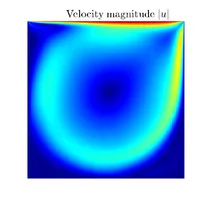
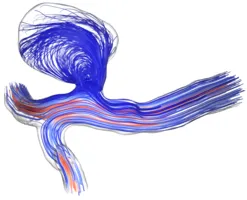
- Lid-driven cavity: Simulating vortices in confined spaces (e.g. blood flow through an artery with aneurysm).
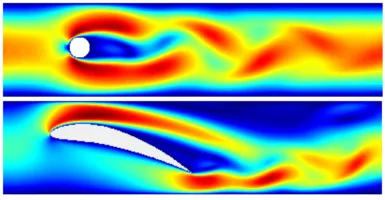
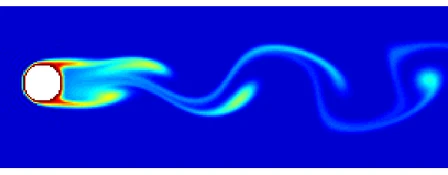
- Von Kármán vortex street: Analyzing flow around obstacles (e.g. drag and lift of an airplane wing)
2. Coupled Flow Processes
As next step, we will couple further components to the flow. Within LBM, such coupling can be easily added, opening the door towards multi-physics simulations:
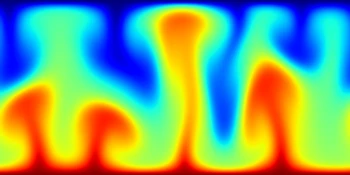
- Heat Convection: Modeling temperature-driven flows (e.g. water heated on the stove, atmospheric weather, industrial manufacturing processes).
- Dissolution & Transport: Simulating chemical species transport (e.g. drug injection into the bloodstream, chemical reactors, river-bed erosion).
3. Porous Media Flow
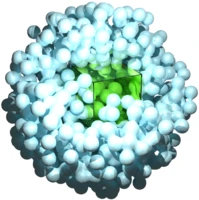
Finally, we consider the interaction of fluid and solid mechanics in form of porous media flow, i.e., flow though pores (“holes”) of a solid material.
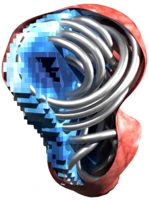
- Everyday & medical applications: brewing espresso, groundwater flow, endovascular devices (thin metal structures) in aneurysms.
- Modeling & simulation: Homogenization procedure, resulting forces, and adapted LBM simulations

4. Experiments & Field Validation
Simulation is only as good as reality. To validate the numerical models, we move beyond the screen and into the field.
- Field Trip: Estimate flow discharge in a nearby creek using the salt dilution method (if weather permits).
- Lab Experiments: Perform controlled flow-through chamber tests.
- Validation: Compare LBM results against physical measurements to ensure their practical accuracy.


Who Should Apply?
This course is the right place for you if you:
- Are interested in applied mathematics and computational physics.
- Have a coding/programming affinity (no prior LBM experience required).
- Want to dive into engineering applications (chemical, natural, or medical science).
- Enjoy a mix of abstract theory, practical implementation, and hands-on field work.
We would be happy to welcome you!